Interactive Walls vs Digital Signage Why Most Lobbies Get This Wrong
By Acid Concepts · · 3 min read
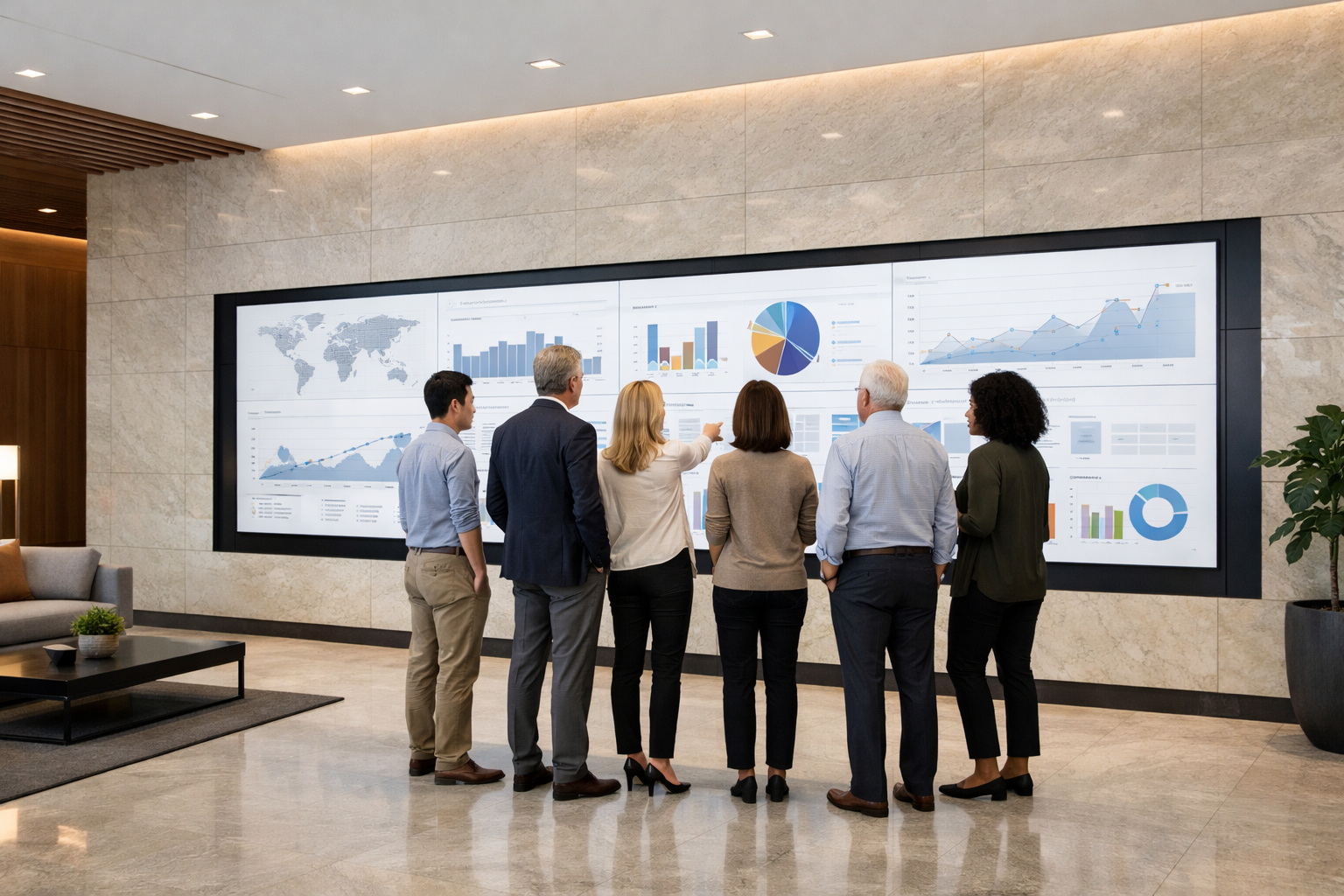
Most organizations install screens in their lobbies, but few design systems that actually guide people. This article explains the difference between digital signage and interactive walls, and why system thinking matters more than the screen itself.
Interactive Walls vs Digital Signage
Why Most Lobbies Get This Wrong
Walk into most corporate offices, hospitals, universities, or hotels and you will usually find one of two things.
A static sign.
Or a screen looping content that no one is really watching.
This is not a technology problem.
It is a systems problem.
Organizations often invest in screens without first deciding what the space needs to do. The result is content that exists, but does not help visitors, staff, or guests move through the space with clarity.
The common mistake
Many organizations choose between digital signage and interactive walls based on novelty, budget, or vendor recommendations.
That approach usually leads to disappointment.
Screens are installed, content is uploaded, and after a short period the display fades into the background. The technology works, but the space does not.
The core issue is that the wall was never designed as part of a system.
What digital signage does well
Digital signage is effective when the goal is simple and repeatable communication.
It works well for:
Event schedules
Announcements
Directional cues
Brand presence
Time based messaging
When designed properly, digital signage reduces reliance on printed materials and allows information to stay current without manual updates.
However, digital signage is passive by design. It assumes people will absorb information as they pass by.
Where digital signage falls short
In complex environments, passive communication is often not enough.
Visitors arrive with questions, uncertainty, and limited time. They are looking for orientation, reassurance, and direction. Looping content rarely answers those needs at the right moment.
This is where many lobbies fail.
What interactive walls do differently
Interactive walls are designed to guide people, not just display content.
Instead of waiting for the right slide to appear, visitors can actively explore information. They can search, navigate, and understand the space on their own terms.
More importantly, interactive walls are designed for groups. Tours, families, teams, and visitors can gather around a shared interface. The experience becomes spatial, visible, and intentional.
The wall becomes part of the architecture, not an accessory.
Interaction is not the point
The biggest misconception is that interaction itself is the value.
It is not.
The real value comes from designing the wall as a complete system that includes:
Clear information architecture
Purpose driven interaction
Content that evolves over time
Operational simplicity for staff
Integration with the physical space
Without this, interaction becomes a novelty rather than a solution.
The hybrid approach most spaces need
In practice, the most successful installations are not strictly one or the other.
They are hybrid systems.
A display wall may function as digital signage most of the time, then transition into interactive mode when someone approaches or touches the wall. This allows the space to communicate passively while still supporting deeper engagement when needed.
This approach requires system thinking, not just hardware.
Designing for real environments
The right solution depends on factors such as:
The type of space
The audience
How often content changes
Staff availability
Visitor flow patterns
Choosing between digital signage and interactive walls without answering these questions almost always leads to underperforming spaces.
Designing systems, not screens
At Acid Concepts, we design interactive display walls as complete systems. Hardware, software, content, and long term operation are considered together.
The goal is not to impress.
The goal is to guide, inform, and reduce friction.
That is what makes a wall successful.
Discuss this with our team: start your project.